





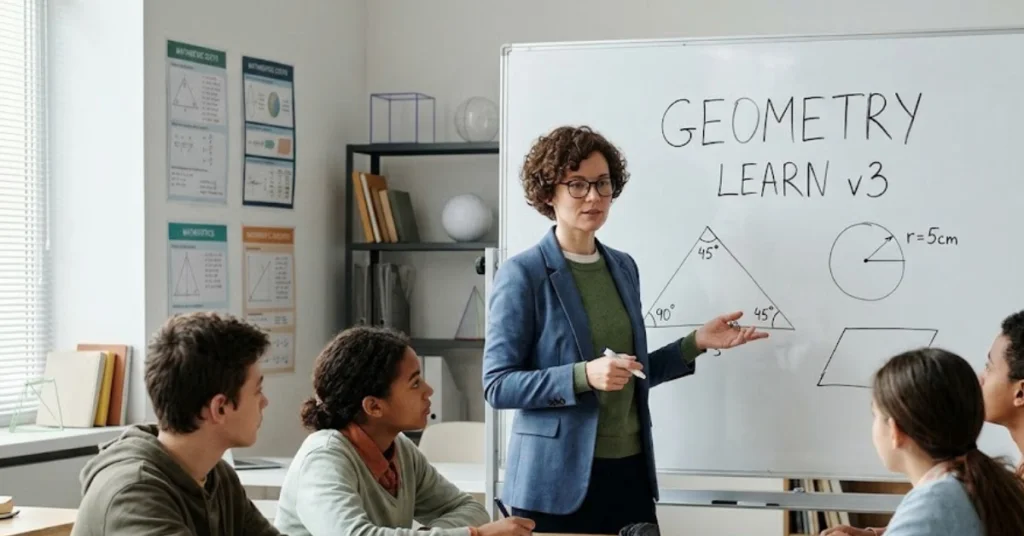
When difficult concepts can be explained simply and practically, it makes learning geometry easier. Many students, parents, and teachers are looking for Geometry Learn V3. This form of learning is not just about memorizing formulas without understanding them, but more about providing a way for the learner to understand how geometry is a solution to everyday problems. It helps children to see the relevance of geometry in their surroundings and to apply it when solving mathematical problems confidently, as each lesson follows naturally from the last. From students getting ready for exams, to parents aiding their children with homework or teachers seeking more effective learning materials, it is easy to get to grips with geometry with the right approach.
What is This Learning Method?
Geometry Learn v3 is a contemporary approach to learning geometry that uses logical steps and clear explanations, as well as practical examples, to help students understand geometric concepts. Rather than rules being presented as a bunch of rules, it helps students to grasp the rationale behind the rules and how they relate to the real world. Difficult concepts are made more manageable; students will gain confidence in mathematics and will have better problem-solving skills, as concepts are broken down into manageable lessons.
What Makes it Different from the Regular Geometry Lessons?
Many students have difficulties dealing with geometry because they have to remember the definitions without knowing what they are for. Geometry Learn v3 takes a different approach, which is to present concepts through observation, seeing, and thinking. Students do not race through formulae but rather playfully find connections between shape, dimensions, and space. This learning approach is useful in building long-term understanding rather than memorizing.
What is the Relationship Between Geometry and Logical Thinking?
There’s a lot more to geometry than just recognizing shapes. All problems must be carefully observed, thought through, and analyzed, step by step. Students are taught how to make comparisons, identify patterns and make conclusions based on evidence, rather than making assumptions. These thinking skills are not only applicable to math but also to science, engineering, technology, architecture, and countless real-life situations that call for thoughtful judgment.
The Reason for Using Basic Concepts When Studying For the First Time
All mathematical understanding starts with easy ideas. Points, lines, angles, and basic shapes should be understood before exploring complex theorems or calculations. These ideas are the base of what is to come. Students may find it difficult to grasp more advanced geometry concepts if they skip the basics, making it fundamental to their learning success to understand these concepts.
What Are The Advantages of Using Visualization in Geometry?
A major advantage of geometry is that it is so apparent in almost every location. Visual learning puts mathematical concepts into perspective by relating them to tangible objects rather than abstract concepts. Windows, books, roads, buildings, clocks, and sports fields are good ways to see geometric patterns naturally. When we see a practical application of the concept, it is easier for students to remember the lesson as they learn from their surroundings.
Many students think that success in math comes from memorizing formulas, but improvement comes from repetition. Students learn to identify patterns, gain accuracy and confidence in solving various types of geometry problems. Each solved problem builds logical thinking skills and helps to diminish the dread that often accompanies math problems. Over time, regular practice helps to make hard-to-understand concepts more familiar.
What are the Benefits of Using How Does Geometry Learn V3 for Advanced Maths?
Once students have begun their studies in geometry, it is closely related to algebra, trigonometry, coordinate geometry, and calculus. Geometric relationships will be the springboard into these topics. With Geometry Learn v3, students are not taught to learn by rote but to think analytically. This solid basis in math allows students to adjust to the more complex academic tasks that occur as they progress.
What are the Common Geometry Learning Mistakes?
Students feel demoralized when they blanch at a question and don’t know what is being asked. Another frequent error is using formulas without understanding the relationship between shapes and measurements. In Geometry Learn v3, students are encouraged to take their time on the diagram, think carefully, and reason logically to minimize errors and enhance retention.
How is Geometry Related to the Real World?
Geometry is in almost every place, whether visible or not. It is used by architects in the design of buildings, by engineers in the design of structures, by designers in the design of “balanced” layouts, and in map applications, it is used for navigation. Geometric thinking is useful in everyday life, even to help determine the size of a room, the dimensions of a garden, and the layout of furniture.
Does Digital Learning Make Geometry Easy?
The current educational technology has changed the way students learn maths. Students can use interactive diagrams, moveable demonstrations, and virtual drawing tools to investigate geometry in various ways. Students will learn by watching, reading dynamic definitions, comparing measurements at a glance, and trying out various solutions, which will make learning more engaging and easier to comprehend.
What are Some Strategies Students can Use to Remember Geometry Concepts for Longer?
To achieve long-term learning, understanding is required, not just repetition. Regularly reviewing the lessons, working through a range of examples, making and using diagrams, and using verbal explanations all help to consolidate memory. Relating geometry to real-life objects also aids in natural recall because visual experiences tend to stick with learners in their memory better than formulas without visual context.
What Skills are Developed by the Study of Geometry?
The ability to learn geometry is much improved by learning geometry. Students develop logical reasoning, observation, analysis, spatial and problem-solving skills while solving geometric problems. These skills are foundational for success in many content areas of the curriculum, and will enable students in their future careers in which planning and organized thought are essential.
Why is Geometry Important in Today’s World?
Geometry is still one of the pillars of today’s innovation even as technology advances and moves at a rapid pace. Geometric principles are essential to fields such as architecture, robotics, engineering, medical imaging, game development, and artificial intelligence. Concepts that are understood allow students to gain knowledge that is relevant to the changing technology in various industries.
What can Parents & Teachers do to Improve Learning?
Repetitive learning does not work as well for students as interactive learning. To foster curiosity, parents and teachers can engage children in identifying shapes in their environments, using real-world measurement problems, and talking to them about geometry in everyday life. Students learn best if they are given positive encouragement and consistent practice to build confidence and make maths less daunting to learn.
Why Geometry Learn V3 is Smart Learning?
The versatility of Geometry Learn V3 is partly due to its emphasis on creating a deeper understanding rather than rote memorization. Every lesson builds on the previous one so that students can build up their confidence in the course of learning before progressing to the next stage. This systematic way of teaching aids students to develop their academic skills and their mathematical thinking at the same time in a non-threatening way.
Conclusion
Geometry Learn v3 is a practical guide to a subject as important to mathematics as geometry, one that progresses logically, is visual, and is practiced regularly. Rather than being a collection of hard-to-remember formulae, geometry is a subject about the understanding of the influence of shapes, length, area, and space on the world around us.
For new mathematical explorers or for reinforcing and building on current skills, learning Geometry will help you make gains that will go beyond the classroom. Geometry is still a fundamental part of education today, whether it’s for everyday purposes or as a stepping stone to future careers in science, technology, engineering, and design. Students can be confident that they are learning concepts one by one and using them regularly so that they can develop skills that will be relevant to their lives.
FAQs
Geometry Learn V3 is what?
It is a teaching method that enables students to grasp geometry conceptually with ease and clarity by presenting them with simple explanations and examples.
Can beginners use Geometry Learn V3?
Yes. Gently introduces concepts, which helps new learners.
What are the topics of Geometry Learn V3?
It contains shapes, angles, measurements, spatial reasoning, and problem-solving skills.
Does Geometry Learn V3 work to boost math performance?
Yes. It enhances logical thinking and establishes a strong mathematics background.
Do you think geometry can be taught by using everyday examples?
Yes. Geometry examples are found in buildings, roads, furniture, sports, and nature.